Research Letters
As transcatheter aortic valve replacement (TAVR) indication is expanding towards younger individuals, more patients are anticipated to experience a bioprosthetic valve failure and will likely undergo a repeat procedure. Indeed, the number of TAVR-in-TAVR is expected to dramatically rise in the coming years and is predicted to exceed the number of TAVR in surgical aortic valve replacement (SAVR) by 2028.¹
A correct crossing is a pivotal step of all valve-in-valve (ViV) procedures (eg, TAVR-in-TAVR and TAVR-in-SAVR), because the inadvertent advancement of the wire through external wrong pathways might lead to ominous consequences like embolization, material entrapment, or prosthesis crushing.²–⁴
Prosthetic crossing might be more challenging than the crossing of a native aortic valve because in this setting the anatomy of the aortic root is completely modified.
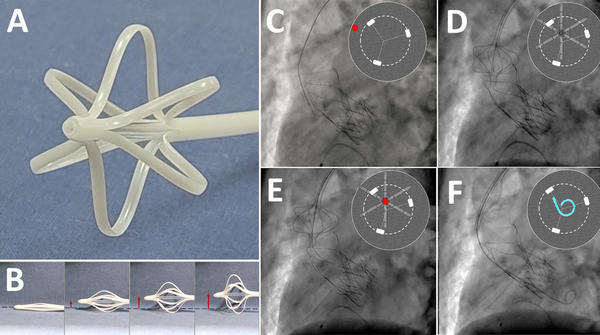
In native aortic valve, the navigation of the crossing catheter occurs in a single space, defined as the aortic chamber, that can be fully explored to deliver the guidewire in the aortic valve orifice. In contrast, in the presence of a surgical prosthesis or a transcatheter heart valve (THV) a second concentric space, the prosthetic chamber, must be necessarily engaged to cross the prosthetic orifice. Indeed, movements of the guidewire outside the prosthetic chamber will not allow crossing or will cause the passage of the wire through the struts or through a paravalvular leak (Fig. 1A).
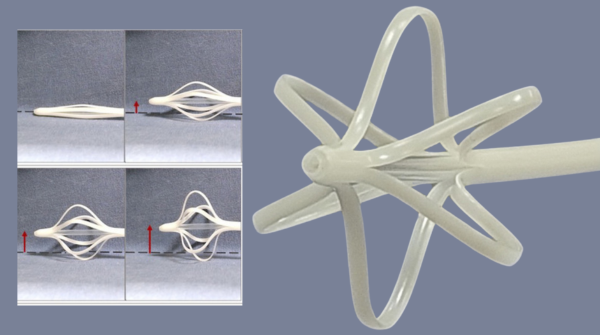
The EasyCross (Fig. 1, B through D) is the first catheter designed to support the positioning of a guidewire within the frame of a surgical or transcatheter aortic bioprosthesis, a crucial step before valve crossing. The device is 12-F compatible and is composed of 2 coaxial tubes: the outer tube displays a distal expandable structure, the “basket,” whose opening allows the distancing of the guidewire from the aortic walls and thus facilitates its placement in the outflow of the prosthetic valve. The opening and closure of the basket is performed by a push-pull action on the proximal portion of the coaxial tube. The internal tube allows the introduction of 0.035-in guidewires and 5-F catheters to perform valve crossing (Video 1).
The aim of this prospective single-arm, single-center, open-label, first-in-human feasibility study (NCT06412354), performed at the IRCCS San Raffaele Scientific Institute, Milan, Italy, was to assess the safety and performance of the EasyCross catheter. The study was approved by the local ethical committee and conducted in accordance with the Declaration of Helsinki. All patients provided written informed consent and were scheduled for the procedure after Heart Team Discussion. The device was inserted through a femoral access, and the percutaneous aortic intervention was performed with the standard techniques.
From February 2024 to June 2024, a total of 20 patients (60% females) with severe aortic stenosis or bioprosthetic valve failure were enrolled in this study. The median age was 82 (interquartile range [IQR] 80.2–84.7) years, whereas the median Society of Thoracic Surgeons’ score was 7.9% (IQR 4.8%–9.9%). Indications for the use of the study device were need of recrossing a THV in 8 patients and failed surgical bioprostheses in 6 patients. Moreover, the safety analysis was extended to 6 patients with native severe aortic stenosis.
The primary safety endpoint (a composite endpoint of freedom from in-hospital death, embolic events, any intraoperative complication due to device malfunction, any systemic infection or allergic reaction) was reached in all patients (100%; n = 20), and at 30 days, no all-cause death or stroke was reported.
Technical success as defined by Valve Academic Research Consortium 3 criteria was achieved in 100% of patients (n = 20).
In all patients with either surgical prosthesis or THV, the device allowed the correct positioning of the guidewire within the prosthetic chamber, as underlined by multiple fluoroscopic projections. In all THV (n = 5 Acurate Neo 2; n = 2 Evolut R; n = 1 Myval) subsequent valve crossing was performed with a standard 0.035-in guidewire and a pig-tail catheter. In 5 of 6 surgical aortic bioprostheses, having gained a safe access to the prosthetic chamber with the EasyCross device, the following leaflets crossing was performed with the usual tools (such as Amplatz left or Judkins right catheter) used for aortic valve crossing, and the EasyCross successfully accommodated these 5F diagnostic catheters. Median crossing time (from device insertion to wire positioning in the left ventricle) was 208 seconds (IQR 166–418 seconds).
Although the results of this study should be interpreted with caution given the small sample size, these exploratory data are promising.
Received for publication May 2, 2025. Accepted July 7, 2025.
See below for disclosure information.
Keywords: valve-in-valve; aortic prosthesis crossing; transcatheter aortic valve implantation
https://doi.org/10.1016/j.cjca.2025.07.007
0828-282X/© 2025 Canadian Cardiovascular Society. Published by Elsevier Inc. All rights are reserved, including those for text and data mining, AI training, and similar technologies.

Figure 1
Aortic prosthesis crossing.
(A) Note the modified anatomy of the aortic root with the prosthesis profile defining a distinct space (the prosthetic chamber) within the aortic root (aortic chamber). In this setting the risk of advancing the guidewire outside the prosthesis frame (white arrow) or through a strut is not negligible. The opening of the EasyCross basket allows a controlled distancing of the device tip (red dot in panel B) from the aortic walls, and its alignment with the outflow of the prosthesis, thus directing the guidewire within the true lumen of the THV (B) or surgical bioprosthesis (C and D). The internal lumen of the EasyCross device is 5 F compatible; therefore, after gaining the true lumen of the prosthetic chamber, subsequent leaflets crossing can be performed with the usual tools used for aortic valve crossing.
With the expected exponential rise of TAVR-in-TAVR, it is of paramount importance to develop strategies to increase the safety of Valve-in-Valve procedures. The EasyCross catheter, enabling the positioning of the guidewire in the prosthetic frame, and avoiding wrong external pathways, might answer this clinical need. Future larger studies are required to further validate our results.
Authors
-
Marco Bruno Ancona, MD a (✉: ancona.marco@hsr.it)
-
Barbara Bellini, MD a
-
Vittorio Romano, RT a
-
Ciro Vella, MD a
-
Christos Papageorgiou, MD a
-
Luca Angelo Ferri, MD a
-
Filippo Russo, MD a
-
Matteo Montorfano, MD a,b
a Interventional Cardiology Unit, IRCCS San Raffaele Scientific Institute, Milan, Italy
b School of Medicine, Vita-Salute San Raffaele University, Milan, Italy
Ethics Statement
The present study complied with the ethical standard of the Declaration of Helsinki and was approved by the Ethic Committee.
Patient Consent
The authors confirm that patients’ consent forms have been obtained for this article.
Funding Sources
None.
Disclosures
Dr M. Ancona received consultant fees from Abbott and Abiomed. Dr B. Bellini received consultant fees from Med-tronic. Prof M. Montorfano received consultant fees from Abbott, Boston Scientific, Kardia, and Medtronic and is the president of the ViVHeart Company. Dr F. Russo received consultant fees from Boston Scientific. The other authors have no conflicts of interest to disclose.
References
-
Genereux P, Leon MB, Dar RD, et al. Predicting treatment of bioprosthetic aortic valve failure in the United States: a proposed model. Struct Heart 2024;9:100339.
-
Vella C, Romano V, Di Maio S, et al. Valve-in-valve transcatheter aortic valve implantation: the issues behind crossing a bioprosthesis. Cardiovasc Revasc Med 2024;62:85–94.
-
Cao D, Albani S, Gall E, et al. Aortic valve-in-valve procedures: challenges and future directions. J Clin Med2024;13:4723.
-
Noble S, Cikirikcioglu M, Roffi M. Massive aortic regurgitation following paravalvular balloon valvuloplasty of an Edwards SAPIEN valve treated by emergent CoreValve implantation: never cross a transcatheter aortic valve without a pigtail. Catheter Cardiovasc Interv 2013;82:E609–12. https://doi.org/10.1002/ccd.24906.
Supplementary Material
To access the supplementary material accompanying this article, visit the online version of the Canadian Journal of Cardiology at www.onlinecjc.ca and at https://doi.org/10.1016/j.cjca.2025.07.007